
 Image 1 of 1
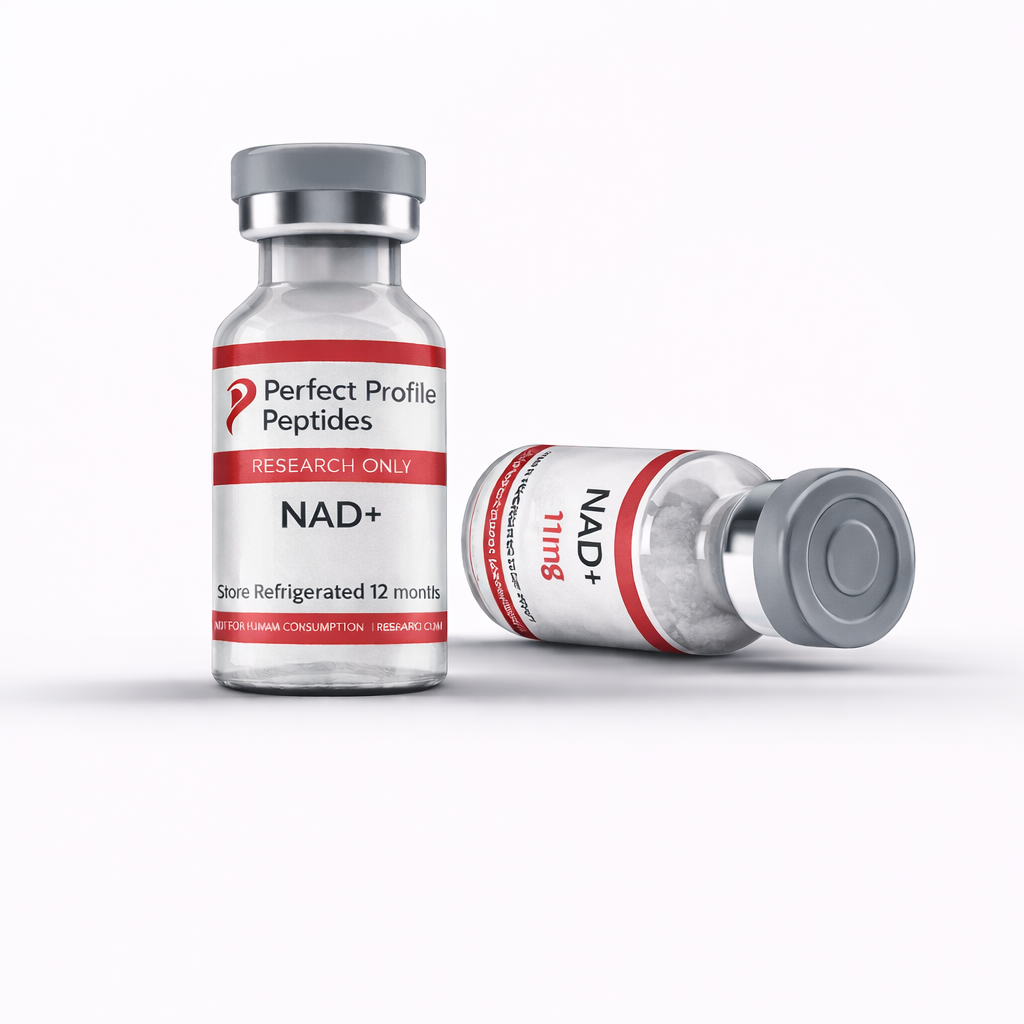
NAD⁺ (Nicotinamide Adenine Dinucleotide) | Research Compound
NAD⁺ is an endogenous pyridine nucleotide coenzyme that plays a central role in cellular redox chemistry and metabolic signalling. As a key electron carrier in processes including glycolysis, oxidative phosphorylation, and mitochondrial energy production, it is one of the most studied molecules in cellular biology. In research settings, NAD⁺ is also investigated for its role as a substrate for enzyme families including sirtuins, PARPs, and cyclic ADP-ribose synthases — pathways linked to DNA repair, chromatin regulation, and calcium signalling.
A note on appearance: NAD⁺ solutions can range from colourless to light yellow depending on concentration and light exposure. This is a normal characteristic of the compound and does not affect quality or purity.
Research Applications
NAD⁺ is used across a broad range of laboratory contexts, including studies into cellular redox balance and mitochondrial function, NAD⁺/NADH ratio dynamics, NAD⁺-dependent enzyme activity (sirtuins, PARPs), and metabolic homeostasis. It is also widely employed as a reference compound in enzymology and in vitro metabolic research models.
Handling & Stability Notes
NAD⁺ is sensitive to temperature fluctuation, hydrolysis under acidic or alkaline conditions, and light exposure. To maintain integrity:
Store sealed, in a cool dry location away from direct light
Avoid repeated temperature cycling — allow cold vials to reach room temperature before opening
In cold conditions, crystallisation within the vial may occur; this is a known physical property of nucleotide compounds and does not indicate a quality defect
Once opened, use within 30 days
Shelf life from production: 30 months (unopened)
Important Notice
All products supplied by Perfect Profile Peptides are intended strictly for in vitro and laboratory research use only. They are not suitable for human or veterinary administration and should be handled in accordance with standard laboratory safety protocols.
NAD⁺ (Nicotinamide Adenine Dinucleotide) | Research Compound
NAD⁺ is an endogenous pyridine nucleotide coenzyme that plays a central role in cellular redox chemistry and metabolic signalling. As a key electron carrier in processes including glycolysis, oxidative phosphorylation, and mitochondrial energy production, it is one of the most studied molecules in cellular biology. In research settings, NAD⁺ is also investigated for its role as a substrate for enzyme families including sirtuins, PARPs, and cyclic ADP-ribose synthases — pathways linked to DNA repair, chromatin regulation, and calcium signalling.
A note on appearance: NAD⁺ solutions can range from colourless to light yellow depending on concentration and light exposure. This is a normal characteristic of the compound and does not affect quality or purity.
Research Applications
NAD⁺ is used across a broad range of laboratory contexts, including studies into cellular redox balance and mitochondrial function, NAD⁺/NADH ratio dynamics, NAD⁺-dependent enzyme activity (sirtuins, PARPs), and metabolic homeostasis. It is also widely employed as a reference compound in enzymology and in vitro metabolic research models.
Handling & Stability Notes
NAD⁺ is sensitive to temperature fluctuation, hydrolysis under acidic or alkaline conditions, and light exposure. To maintain integrity:
Store sealed, in a cool dry location away from direct light
Avoid repeated temperature cycling — allow cold vials to reach room temperature before opening
In cold conditions, crystallisation within the vial may occur; this is a known physical property of nucleotide compounds and does not indicate a quality defect
Once opened, use within 30 days
Shelf life from production: 30 months (unopened)
Important Notice
All products supplied by Perfect Profile Peptides are intended strictly for in vitro and laboratory research use only. They are not suitable for human or veterinary administration and should be handled in accordance with standard laboratory safety protocols.